《夜雪初霁图》:寂静中苏醒的光 一、材
 Midjourney Bot
更新时间:2025-12-22
00:01:23
Midjourney Bot
更新时间:2025-12-22
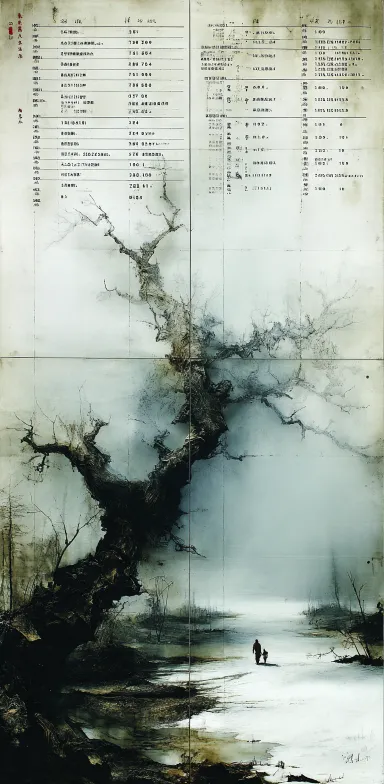
00:01:23提示词:Night Snowfall: Light Awakening in Silence. 1. Material and Snow Scene Base. This work uses 138x68cm antique Xuan, with a natural "orange peel pattern" texture on the paper surface. Before painting, Lin Yan dyed the entire paper with extremely light indigo ink and infused it with a cool snow night background. If there is a seemingly non-existent gray and blue color in this layer, it determines that all the snow in the future will not be pure white, but cold white soaked in the cold night air. 2、 Color: From cold to slightly warm, the full painting color is delicately balanced between the cold and hot poles: the cold color system is composed of five "snow ink" colors: the deepest is "shadow snow color": light ink plus 15% indigo, used for shadows deep in the ice layer; the middle tone is clear light ink, used for general snow cover; the light receiving surface is "soft snow color": light ink plus 5% clam powder, presenting a matte texture; the highlight retains the original color of the rice paper; the "air snow color" indigo ratio reaches 30%, showing the hazy and warm colors in the distance, with only two remaining: 1 Mud Gold Star: Pure mud gold vertically dyed, slightly convex after drying, producing a solid like faint light under light Lonely Pavilion Lights: Based on ochre, mixed with trace amounts of cinnabar and rattan yellow, diluted into amber color, divided into three layers from inside to outside, with the outermost layer light to no trace. Composition: The triple snow scene is vertically divided into three spiritual spaces: the close-up (30% below) is a snow covered cold forest. Lin Yan used a dry pen and light ink to write the main stem, while the thin branches were "swept" with drier ink lines, transforming into silhouettes stretching towards the sky. The snow cover is minimalist: the upper surface of the branches is completely white, and the lower surface is painted with a "shadow snow color", giving a sense of weight to the branches with just one stroke. The snow layer on the ground is lightly ink stained with undulations, and it is slightly deeper near the tree trunk, like snow accumulating when encountering obstacles. Zhongjing (middle 40%) is the spiritual center. The left gentle slope snow mountain texture is restrained, with only a slight "folded band texture" implied by light ink dry brush. The expression of snow is concentrated on the ridge line: all the snow on the sunny side is left blank, and the snow on the shady side is rendered with extremely light blue ink, with a natural transition. The solitary pavilion at the foot of the mountain is outlined with fine ink lines that are as thin as hair strands, and the lines are softened by the cold. There is no one in the pavilion except for that lamp. The distant view (30% above) depicts the night sky at dawn. The extremely light floral green ink layer by layer renders a deep sense of depth- slightly thicker near the mountaintop, gradually fading upwards. In the upper right corner of the screen, irregular gaps in the cloud layer open, revealing a mirror like sky of azure blue behind (with a small amount of ink added to the head). Above this depth, two or three mud stars quietly emerge. 4、 Core technique: Breathing of light and snow. The "breathing sensation" of snow is achieved through the "leakage dyeing method": after laying the color with a light ink pen, immediately use a clear water pen to gently guide the edge of the color block, and the ink naturally penetrates into the white area, forming a furry transition. Snow is therefore not a solid cover, but a soft existence that is subtly interacting with the surface of the object. The dialogue between the star lights is achieved through precise composition: the brightest mud gold star and the lights in the pavilion are on the same invisible diagonal line, running through the spiritual axis of the picture. The contrast between starlight cold gold and warm brown lights creates a temperature difference, but resonates with the imagery of 'perseverance in loneliness'. Lin Yan controls the blending range of the lights and the brightness of the starlight, creating a visual balance of "light pressure" between the two- although the lights are close and subtle, the starlight is far and sharp, producing an equal amount of spiritual attraction. The moment of "Chuji" is characterized by a tense tranquility: the edge of the cloud crack is repeatedly blurred with a clear water pen, as if the mist is slowly dissipating. The deep blue night sky within the fissure is flat and free from cloud interference- this is the first clear gift given by the world after a long snowy night. 5、 Artistic conception: Awakening in waiting. The painting "The Early Clearing of Night Snow" depicts the form of "waiting". All things wait in silence: the snow capped mountains await the morning light, the lonely pavilion awaits the returning people, the cold forest awaits the spring breeze, and the night sky awaits the stars. There is no one in the pavilion but there are lights, and the night sky has no moon but cold stars. This' absent presence 'constitutes the deepest poetic meaning of the painting. The light proves the existence of human beings- perhaps only temporarily away, but that warmth firmly declares: in the vast cold, there is still a steadfast body temperature. Starlight comes from a distant promise, traveling through time and space to reach the present moment, proving that the universe has its own constant radiance. This work completes the transition from "scars" to "healing" in Lin Yan's aesthetics. It does not present the form of trauma ("Fragmented Mountains and Rivers"), does not listen to the sounds of trauma ("Listening to the Waves in the Mist Gully"), and does not explore the depths of trauma ("The Crack Brings Clouds"), but presents a silent gap between "after" and "before"- all things are not fully illuminated, but light has begun to inhale and exhale; The cold has not subsided, but the warmth has been ignited. When the viewer stands in front of this painting, they will experience a triple awakening: first feeling the grand silence of the snowy night, then paying attention to the starry sky and lights, and finally realizing the silent dialogue between the two. This painting does not offer passionate redemption, but only provides evidence: in the darkest and coldest, light, no matter how small, will always find a form of existence; Warmth, no matter how lonely, always meets the stars that echo it. This is Lin Yan's winter poem, telling everyone who has experienced the long night: in the deepest darkness, the first light that shines is often not the sun, but the lamp you light for yourself, and the first star you see when you look up. --ar 68:138 --v 7 --stylize 100 --sref https://resource.gogptai.com/aigf/origin/20251221/1766329592389789_4.png --no Text,characters
素材来源:Midjourney中文版
Copyright©2017 Midjourney9.com All Right
Reserved 版权所有:成都金翼云科技有限公司 蜀ICP备2023008999号