一、 场地分析与设计挑战 您的场地示意图
 Midjourney Bot
更新时间:2025-11-10
00:01:51
Midjourney Bot
更新时间:2025-11-10
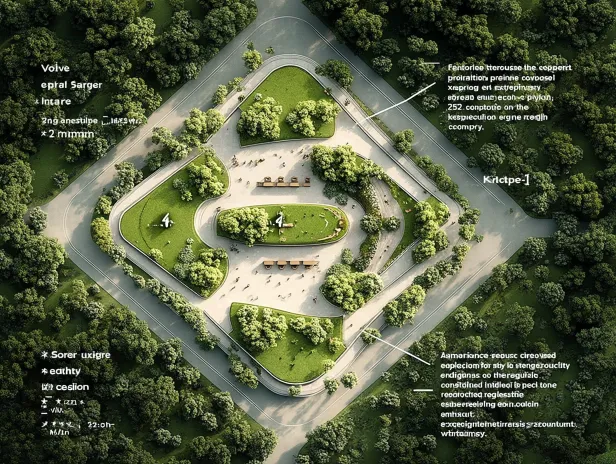
00:01:51提示词:https://images.gogpt.vip/aigf/m_origin/20251109/1930503/hhr2ky72c9a3uq6a.jpeg 1、 Site analysis and design challenge: Your site schematic clearly displays a narrow trapezoidal space (approximately 50 square meters). This is the core challenge of design and also the starting point of creativity. Shape characteristics: Depth (8 meters) is greater than surface width (4.95 meters for upper bottom and 7.92 meters for lower bottom), with obvious directionality and perspective. The design should utilize this feature to guide visitors to explore from the entrance towards the interior. Spatial sensation: It is easy to appear narrow and oppressive. The solution is to create a rich experience of "seeing the big in the small" through clever spatial partitioning, such as segmentation, undulations, and occlusion. Surrounding relationship: There are "adjacent booths" on both sides, which means that the side view is limited, and it is necessary to focus on creating landscapes in the front and back (entrance and end). The "lawn" areas in front and behind can take advantage of the scenery and integrate the garden into a broader environment. 2、 Design concept direction suggestion: A "ecological corridor" for exploration and discovery. We can conceptualize this narrow base as a condensed ecological exploration corridor, allowing visitors to experience a complete "eco-friendly community garden" journey in just 8 meters. Example of Theme Naming: "Diecui Huilang" or "Neighborhood Ecological Valley" Diecui: Refers to the richness of plant layers and the superposition of ecology. Huilang: Refers to both the physical form of a corridor and the symbolic gathering place for community interaction. Neighborhood Ecological Valley: emphasizes community attributes and a sense of enclosure that converges from both sides towards the center. 3、 The specific implementation strategy of the trinity (ecological, social, educational) will divide the garden into three functional sections along an 8-meter depth, progressing layer by layer: the first section is the entrance interactive area (social first, about 2-3 meters deep), with functions of attraction, stay, and preliminary interaction. Design technique: Welcome node: Set up a low arched or scenic wall made of recycled wood or ecological cement, which can be embedded with porcelain tiles or QR codes with community imprints (introducing garden concepts), and clearly define the entrance. Interactive facilities: One side is equipped with a shallow rainwater collection display device (combined with ecological education), and the other side is equipped with a set of lightweight mobile seats or low wooden steps for people to rest and communicate briefly. This is the 'living room' of the garden. Plant configuration: Mainly featuring bright and fragrant ornamental grasses and seasonal flowers such as sage and snowball, creating a friendly and warm atmosphere. Second paragraph: Ecological core area (ecological and educational core, about 3-4 meters deep) Function: Display ecological technology, biodiversity, and provide immersive experiences. Design technique: Terrain creation: Micro terrain treatment is applied to the ground to form gentle slopes, breaking the monotony of narrow spaces. The path can be transformed into a winding gravel or wooden boardwalk. Ecological Technology Exhibition: Insect Hotel: Utilizing recycled wood, bamboo tubes, pine cones, etc. to provide habitats for insects. Composting bin: designed as a beautiful wooden box, labeled "Garden Kitchen", showcasing the process of turning kitchen waste into treasure. Local Plants and Honey Source Plant Belt: Planting local plants from Shanghai (such as Luoshi and Drunken Fish Grass) and honey source plants that attract butterflies and bees (such as Whiplash and Aster), hanging introduction boards, this is the most vivid biodiversity conservation classroom. Vertical greening: Using the boundary walls on both sides or setting up grilles, planting climbing plants (such as Lingxiao and Morning Glory) to increase greenery and improve microclimate. Third paragraph: Quiet contemplation area (educational and social sublimation, about 2-3 meters deep) Function: quiet observation, thinking, solitude, or small-scale deep conversation. Design technique: Visual focus: Set up a core landscape, such as a small mirrored water feature (recycled water, controllable cost) reflecting the sky and clouds, or an interesting "seed sculpture". Enclosed space: Create a relatively private corner through tall green plants such as slender bamboo poles and ornamental grass screens. Educational Extension: Set up a "touchable" plant planting box, plant edible vanilla plants (mint, basil), hang signs introducing their habits, embody the concept of "edible landscape", and convey low-carbon and self-sufficient thinking. 4、 Plant and material suggestions (suitable for Shanghai's April May flowering season) Plant selection: Skeleton plants: Use a small amount of ornamental grass (such as wolfberry) or evergreen shrubs (such as water lily) to set the tone. Theme flowers: mainly in blue purple and white colors, creating a peaceful and elegant atmosphere. Recommendations: Sage, Swallow Grass, Feather Bean, Rehmannia, Mexican Sage, etc. They bloom in spring, have beautiful shapes, and are excellent nectar plants. Bottom layer covering: using organic coverings such as bark and phosphorus to moisturize and suppress grass, reflecting ecological management. Material selection (cost control within 70000 yuan): Main materials: prioritize the use of recyclable wood, bamboo, ecological cement bricks, and local stone/gravel. These materials are simple, environmentally friendly, and relatively controllable in cost. Sketch: Use old objects as much as possible for renovation (such as old tires for planting ponds, old pottery jars for water features), reflecting the low-carbon concept. Summary: Design highlights the disadvantage as an advantage: transforming narrow terrain into a rhythmic "exploration journey", avoiding flat and straightforward narration. Narrative layout: From front to back, form a complete narrative logic of "attraction exploration contemplation", closely related to the topic. Perceived ecology: Ecological technologies such as composting, insect houses, and rainwater harvesting are directly displayed as landscape elements, making "eco-friendly" visual and understandable. Age friendly details: gentle slopes, touchable herb gardens, interesting signage, catering to the different needs of children, adults, and seniors. Garden background, --ar 4:3 --v 7 --stylize 100 --iw 0.25 --sref https://images.gogpt.vip/aigf/m_origin/20251110/1930503/1q3z3x6xw9f0sc1i.jpg --oref https://images.gogpt.vip/aigf/m_origin/20251110/1930503/1q3z3x6xw9f0sc1i.jpg --ow 400
素材来源:Midjourney中文版
Copyright©2017 Midjourney9.com All Right
Reserved 版权所有:成都金翼云科技有限公司 蜀ICP备2023008999号